
April 1, 2 & 3, 2026, CELSA - Sorbonne Université (Neuilly-sur-Seine)
Download the programTélécharger le programme complet
Since its inception in 1956, the Eurovision Song Contest (ESC) has launched the careers of global stars such as ABBA and Celine Dion. Multicultural and multilingual, and unmatched in scale outside the Olympic andParalympic Games, the ESC has become a fixture of the European public media landscape. On the eve of its seventieth anniversary, the ESC crystallizes a wide range of issues: the staging of shared identities and geopolitical rivalries; the construction of normativities and representations; and the questioning of cultural legitimacy and its antithesis.
Studying the ESC thus entails exploring the intersections of identity, collective rituals, and social media participation, while also illuminating the complex political and social dynamics within the cultural and media industries. To what extent can the humanities and social sciences help us to illuminate, understand, and critically analyze the social, cultural, and political issues—both past and present—embodied in the ESC?
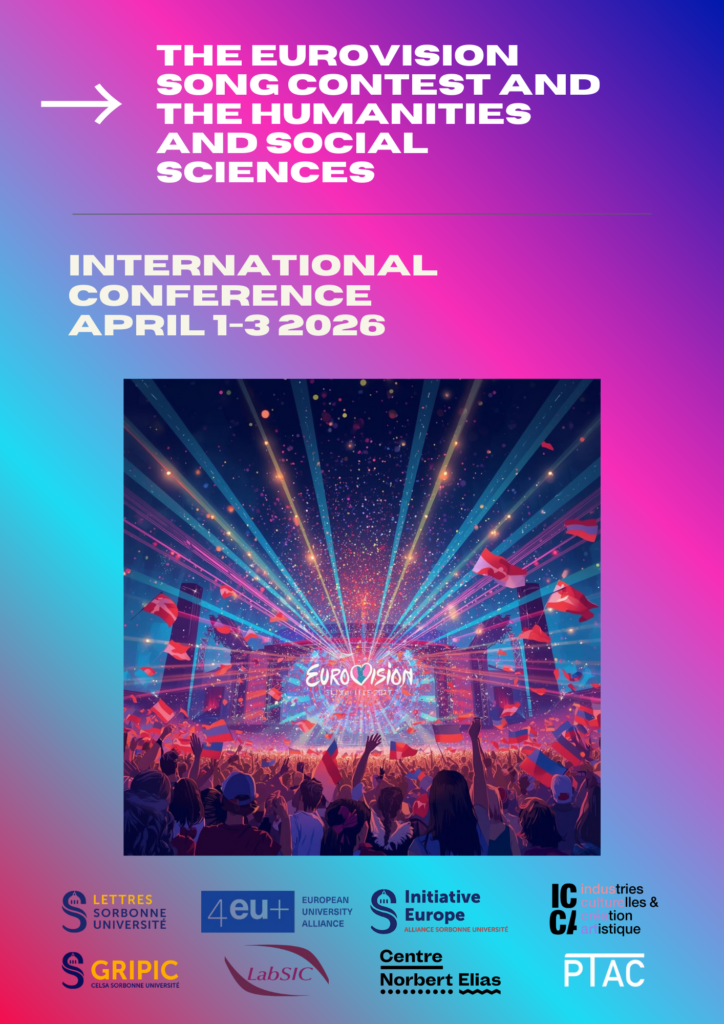
The conference “Eurovision Song Contest and the Humanities and Social Sciences” sought to build upon the collective initiatives that had helped establish an interdisciplinary state of the art in ESC research. Adopting an interdisciplinary and critical perspective, the conference aimed to explore and interrogate emerging approaches and studies related to the contest and its multiple dimensions.
The discussions at this conference were structured around the following central research questions:
- How are the humanities and social sciences approaching the ESC? Conversely, how might the ESC stimulate and challenge the theoretical frameworks and methodologies of these disciplines?
- Is the ESC an original social object with its own distinct questions and methods, or does it resemble other research topics that pose similar analytical challenges?
- Does current research on the ESC reflect a profound renewal of academic approaches, or is it primarily shaped by long-term dynamics involving the revision and adaptation of existing themes, objects, and analytical frameworks?
- What do analyses of the ESC contribute to the humanities and social sciences, particularly in terms of methodological tools, and interpretive perspectives?
- How do disciplinary orientations and the ethnocentric perspectives of researchers shape their interpretations of the ESC and influence their research practices?


The organization of this conference served as a springboard for the establishment of an international research network: titled ENCORE (Eurovision Network for Collaborative Research and Exploration), this network will focus on how the ESC could be studied at the intersection of various approaches, disciplines, and research objects. It also aims to foster dialogue between science and society surrounding the contest. A wide range of non-academic partners—fan clubs, media outlets, businesses, and institutions—will be invited to initiate an open dialogue within the network, ensuring socially-grounded research and a meaningful exchange of knowledge between the various stakeholders involved in the Eurovision Song Contest.
In this spirit, the conference alternated between sessions dedicated to the presentation and discussion of ESC research, participatory workshops to define the objectives and cooperation methods of the ENCORE network, a cultural evening dedicated to the ESC on April 2nd in partnership with the 12 Points podcast, and cultural visits reserved for symposium participants (April 3rd).
This symposium was supported by funding from the Research Intervention Fund of the Faculté des Lettres (Sorbonne Université), the 4EU+ European University Alliance, the Europe Initiative (Sorbonne Université), the Doctoral School 5 « Concepts & Langages » (Faculté des Lettres – Sorbonne Université), the ICCA InIdex, and the research laboratories GRIPIC (CELSA – Sorbonne Université), LabSIC (Université Paris Nord), Centre Norbert Elias (Avignon Université), and PTAC (Université Rennes 2).
This conference was organised by scholars specializing in the study of Eurovision Song Contest, representing four French universities.

Sébastien Appiotti is Associate Professor at CELSA – Sorbonne University.
His research focuses on photographic practices in cultural contexts, the digital transformation of cultural institutions, and the Eurovision Song Contest.
He has conducted extensive fieldwork in France and abroad, in museums and cultural institutions such as the Grand Palais, MoMA, and the Smithsonian Institution.
Author of Prendre des photos au musée? (2022), he has also co-edited several collective volumes on semiotics and communication.
He is regularly invited by media outlets (France Culture, Libération, Huffington Post, M6, among others) as an expert on contemporary cultural practices.

Lisa Bolz is an Associate Professor at CELSA Sorbonne University. Her research focuses on media history, digital and international journalism, digital media cultures, and the Eurovision Song Contest.

Johan Boittiaux is Associate Professor of Communication and Media studies at Sorbonne Paris Nord University. A member of the Labsic research center, his work explores cultures of entertainment, tourism, and leisure through multiple perspectives, including professional discourses and practices, the scenography of spaces, audience appropriation, and the mediatization of societal and environmental issues. His research particularly examines the intersections between cultural industries, societal transformations, and the reshaping of spatial environments.

Philippe Le Guern is a full professor of art theory and anthropology of contemporary worlds at the University of Rennes 2. His research focuses on the « politics of sound » and how art and culture record and reveal the changes in the contemporary world. Part of his work and publications focus on Eurovision Song Contest, and its viewers and fans.

Marie-Caroline Neuvillers has been an Associate Professor at the University of Avignon since 2021. Her research focuses on media dispositifs and forms, particularly in digital contexts, and on their appropriation by audiences, while also examining their articulation with and connections to so-called traditional media. Among her current research projects, she investigates the circulation of touristic imaginaries as well as media representations of the Eurovision Song Contest.